|

|
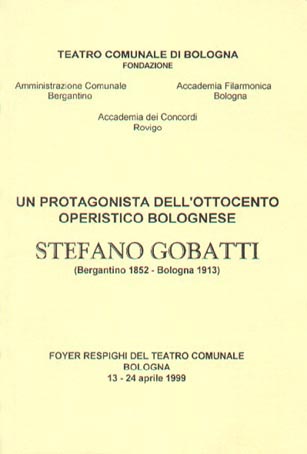
Stefano Gobatti, un protagonista dell’Ottocento operistico bolognese, exhibition held at the Respighi foyer of the
Teatro Comunale in Bologna (13-24 April 1999), by Tommaso Zaghini, Corrado Ferri
and Luigi Verdi.
The
exhibition was reproposed at the auditorium of the Palazzo Municipale in
Bergantino
(10-19 September 1999).
Video report (Tele Estense):
Real Player 80 Kbps 2.3 MB
Video interview (Tele Estense):
Real Player 80 Kbps 8.8 MB
There
is a deep link between Polesine composer Stefano Gobatti
and Bologna. In the
prestigious teatro Comunale of Felsina city, infact, there blossomed and
realized the young composer’s
hopes: when he was about twenty years old, he met with an incomparable
success in the history of melodrama.
 Incontro
con Piero Mioli, Luigi Verdi e Tommaso Zaghini (21 aprile 1999) Incontro
con Piero Mioli, Luigi Verdi e Tommaso Zaghini (21 aprile 1999)
Buonasera e benvenuti a quest'incontro dedicato a
Stefano Gobatti, in occasione della mostra allestita nel Foyer Respighi del
Teatro Comunale di Bologna. Desidero innanzitutto ringraziare il Sovrintendente
del teatro Felici a Bottino, il Direttore artistico Gianni Tangucci e il capo
ufficio stampa Michele d'Agostino, che hanno reso possibile la realizzazione di
questa mostra, un cordiale ringraziamento anche al Presidente dell'Accademia
Filarmonica di Bologna Fulvio Angius e a Laura Negri, Sindaco di Bergantino,
comune in provincia di Rovigo, paese natale di Gobatti. il materiale esposto
nella mostra proviene per lo più' dal Fondo Gobatti della Biblioteca di
Bergantino, diretta dal Professor Tommaso Zaghini, che e' qui presente,
nonostante un grave recente incidente automobilistico, il quale interverrà nel
corso dell'incontro. E' qui presente anche il professor Mi oli che introdurrà'
l'incontro tracciando un panorama storico dell'epoca nella quale Gobatti si
trovo' ad operare.
Per questa occasione e' stato predisposto questo opuscolo illustrativo Un
protagonista dell'ottocento operistico bolognese. Stefano Gobatti, opuscolo
curato da Tommaso Zaghini e Corrado Ferri, che e' a disposizione di tutti gli
intervenuti. Per chi volesse saperne di più' vi ricordo che gli stessi Zaghini e
Ferri hanno pubblicato un libro Stefano Gobatti.
Il musicista che fece impazzire Bologna edito da Bongiovanni.
Avremo anche la possibilità' di ascoltare alcuni brani tratti dall'opera più'
conosciuta di Gobatti, i Goti, che messa in scena al Teatro Comunale
nell'autunno 1873, ottenne un clamoroso
successo. Prima di entrare nel vivo dell'incontro, vorrei subito ascoltare una
breve lirica di Stefano Gobatti, tratta da un ciclo di quattro liriche
conservate nell'archivio storico dell'Accademia
Filarmonica, l'importante e antica istituzione musicale bolognese, che si e'
fatta promotrice della riscoperta della musica di Gobatti. Tra l'altro vedo in
platea una folta rappresentanza
dell'Accademia Filarmonica di Bologna e del Comune di Bergantino, col sindaco
Laura Negri; sono in sala anche alcuni parenti di Gobatti, che saluto
cordialmente.
Luigi Verdi
Stefano
Gobatti was born in Bergantino (province of Rovigo) in 1852 from a humble family
of peasants. In spite of his relatives’ hesitation, he followed his natural
talent and studied music so as to arrive at Bolognese maestro Giuseppe Busi’school
and then, in Milan and Naples, at maestro Lauro Rossi’s. When he was only
eighteen years old, he composed, as an exercise, an opera entitled “I Goti”.
Lauro Rossi convinced him to have it performed and the work went on the scenes
on 30 Novermber 1873, at the Teatro Comunale in Bologna.
It was an unprecedented success and, in a few weeks, the unknown little
maestro was glorified and honoured with the honourary citizenship of Bologna,
the honourary membership of the Accademia Filarmonica in Bologna, the
appointment to Knight of the Italian Crown given by Vittorio Emanuele II.
Gobatti’s
enormous success was achieved in a historical moment of confusion in the Italian
musical art. In 1871, Wagner had presented Lohengrin right at the Teatro
Comunale in Bologna: it was the first time that one work by the German composer
was put on in Italy and it was a revolution. It
was made an idol of him in Bologna. On the
contrary, Milan, a Verdian city, opposed Wagner since the man from
Busseto was recognized as the indisputed top of the Italian melodrama tradition.
They were years of an intense passion for opera, which resulted in burning
antagonism: the successful operas in Bologna often used toplk flop miserably in
Milan. Even musical critics used to show some confusion in their opinions,
though apparently indisputable.
Gobatti
and his music were unexpectedly considered as close to Wagner, although the
“Bolognese” composer had not even seen the title page of one of the German
composer’s works. Yet Bologna had been too impatiently looking forward to
being the place of artistic birth of one
star of its own and twenty-year-old unwary Gobatti, became one “Case”, the
expected idol to be opposed to Verdian Milan. This could do
nothing but damage the young Maestro: his music did not have the honour of a balanced critical opinion; his artistic path began at
the top of an indisputed success which was impossible to maintain. Therefore,
while I Goti were being successful in the most important Italian theatres, the
ingenuous and unexperienced Maestro started to be plotted behind. He was also an
easy prey to publishing houses and
to their merely economic interests, and his following operas, Luce (1875) and
Cordelia (1881) were inevitably marked by contrasts and adversities. Gobatti
wrote to Tito Ricordi a few years after Cordelia’s flop as follows: “a thick
veil arose between me and humanity, whith whom I did not want to have
relationships any longer”. Yet, they were years of intense creative fervour:
little by little, difficulties undermined Gobatti’s health, but his isolation
fostered his musical inspiration.
In
those years he was busy working on church and chamber music, he revised I Goti,
the work which had given him honour and fame and to which then he connected his
hopes of being back to success. He also planned one French version of it. He
wrote a new opera called Massias. He held a correspondence with true friends and
with the most prominent figures in the musical field of his time. In 1885 he
conducted a vocal and instrumental concert with his own compositions at the
Teatro Comunale, where he presented church and chamber music pieces. In 1898 I
Goti were put on scene once more in Bologna, at the Teatro Politeama
D’Azeglio: it was a success, again. Then, silence came.
Yet,
during these years, the “Gobatti case” has never been closed. All the
“histories of music”, infact, mention I Goti, but practically no researcher
has ever examined the scores, nor listened to music performances, and all of
them have always taken as a reference point for their judgements, the appraisals
dating back to the second half of the 19th century, a transition period of
confusion and of excessive melomaniac fervour. The opera I Goti revealed
Gobatti’s talent in a too violent and unexpected way; he was surrounded with
an atmosphere of great expectations and hopes which was followed by a possibly
excessive disillusionment. Triumph and silence: two extreme positions which it
is necessary to examine closely today, out
of any passion. After the years of excess, Maestro Stefano Gobatti
deserves a fair, objective and detached judgement.
Corrado
Ferri and Tommaso Zaghini
Click here
to request the complete text (Italian version only)
|
 |


