|

|
M
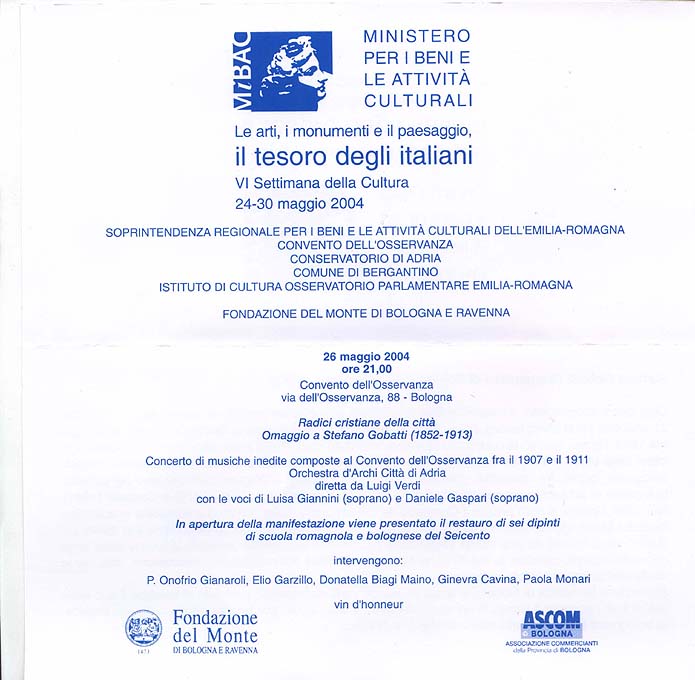
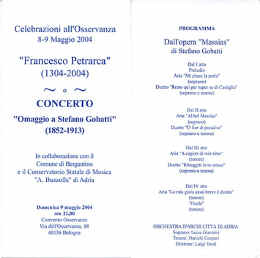
Omaggio
a Stefano Gobatti, nell’ambito delle Celebrazioni all’Osservanza
(Bologna, 9
maggio 2004) e in occasione della VI settimana della cultura del Ministero dei
beni e della Attività culturali (Bologna, 26 maggio 2004).
Orchestra d'archi Città di Adria. Soprano: Luisa Giannini. Tenore: Daniele
Gaspari
Direttore: Luigi Verdi
Recensioni:
Chiesa cattolica, Bologna, 1 maggio 2004 (Chiara Sirk)
Quadrivio, Rovigo,
Ritorna alla luce il “Messias” di Stefano Gobatti, giugno 2004, p. 16
(Tiziano Bedetti)
|
Around 1870, Stefano Gobatti had a period of great
popularity, when his first opera I Goti, prémièred in Bologna in
December 1873, met with such enthusiastic success that it was recorded by
historians as one of the most resounding successes of the whole history of
serious opera. Gobatti was awarded the Bolognese honorary citizenship when
he was only 21, but after I Goti had been staged successfully in the most
important Italian theatres, his following operas, Luce (1875) and Cordelia
(1881) were less successful, while his last work Massias was never staged.
Gobatti spent the final period of his life as a guest at the Osservanza
Convent in Bologna. He is buried at the Certosa of Bologna. Today we can
listen to Gobatti’s music with a new attitude, without prejudice, and
appreciate its value in full: rediscovering the music by Gobatti, a
musician who marked a period of the Bolognese and Italian musical life of
the second half of the 1800s, is a remarkably valuable cultural initiative.
Stefano
Gobatti wrote the Massias from 1905 and 1912, after his intimate need to
express his inner world through the artistic language of music, which
suited him particularly, also attracted by the tender story of the
troubadour Massias, who lived around the half of 12th century. Many
influential people were interested in staging Gobatti’s new opera, which
had already been orchestrated, but had to face the maestro’s reluctance,
as he had been living too isolated to reenter the tumultuous life of
theatre.
The few people who could listen to the music of Massias privately reported
that it was really good ant that it was certainly the maestro’s
spiritual will.
Today the score of Massias is held at the Fondo Gobtti of the Biblioteca
Comunale of Bergantino (Rovigo, Italy). Some relevant pages of the opera,
after the critical revision by Luigi Verdi, are presented to the public
for the first time, in the version for string orchestra.
|
|
 |